A promise the stores could not keep
A Delhi electronics retailer launched online pickup to turn web traffic into store visits. The website treated overnight stock counts as available inventory and sent pickup confirmation immediately. By afternoon, floor staff sometimes sold the same units to walk-in shoppers. The call centre could cancel orders but had no view of whether a replacement was available at a nearby store.
Operations director Kavya Menon had a month to improve the service before the next promotional period. The ecommerce team wanted to add reminders. Store managers wanted reservation software and argued that more messages would make little difference when the product was missing. Finance wanted one pilot that could be evaluated on contribution.
What the process can change
A reservation pilot would assign picking to a store colleague, hold the item against the web order and send a ready-to-collect message after a scan. A reminder pilot would send two messages to customers whose items were ready. The first has higher implementation cost. The second could start quickly, but it addresses a different failure point.
The operations team proposed using monthly retained pickups and the margin after added costs. Store leaders added two safeguards: picking could not materially increase checkout wait, and the reservation process could not lock scarce stock for long enough to harm walk-in availability.
Exhibits
| Outcome | Orders |
|---|---|
| Completed | 750 |
| Stock-related cancellation | 160 |
| Customer no-show | 90 |
| Intervention | Expected failures prevented | Monthly equivalent cost |
|---|---|---|
| Reserve and confirm | 80 stock failures | ₹18,000 |
| Reminders | 30 no-shows | ₹5,000 |
Discussion questions
- Find the largest failure point and distinguish its share of all orders from its share of failed orders.
- Compare both pilots financially. At what recovery volume does each break even?
- Design a store test and describe the operational trade-offs that could reverse your recommendation.
Teaching note
Reveal the visual and solution
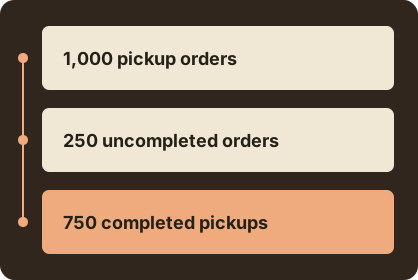
Locate the failure in the journey
Completion is 75%. Stock failures are 16% of all orders and 64% of the 250 failures. Observe the sequence from promise to reservation, picking, confirmation and collection. A confirmation that precedes the pick can cause a customer to travel for stock the store has already sold.
Compare gains after costs
The reservation pilot earns 80 × ₹320 − ₹18,000 = ₹7,600 and needs at least 57 recovered orders. Reminders earn 30 × ₹320 − ₹5,000 = ₹4,600 and need at least 16. If reservations recover fewer than 71 orders, their modeled contribution falls below the reminder forecast. The pilots target separate failures, but recovery estimates could overlap once the first change alters who is eligible for the second.
Pilot reservations in matched stores
Start with accurate-inventory stores, match on volume and cancellation rate, and compare completed orders and contribution over the same weeks. Track inventory lock time, customer travel complaints, walk-in stockouts and staff minutes. Add reminders as a separate experiment after the ready-to-collect population stabilizes.