Should a Jaipur tea brand renew sampling?
Jaipur, Rajasthan · Fictional practice case
The renewal meeting
On a Monday morning in Jaipur, category lead Meera Rao had until noon to reserve tasting staff for the next four weekends. Her distributor wanted all twelve demonstration booths back. Orders in those shops had risen by 430 packs, a result that looked like a clear win on the sales dashboard. Finance had a different question: how many of those packs would have sold anyway?
The brand sold packaged tea through neighbourhood kiranas and larger grocery shops. Store owners controlled the shelf, and the distributor could offer a tasting booth only where the proprietor agreed to provide floor space. The campaign used the same pack and selling price as the previous period. Promoters served small cups and pointed shoppers to the existing shelf.
What the field team knew
The sales team had chosen shops where owners reliably reported stock and had enough weekend traffic to justify staffing. Six were in commuter-heavy neighbourhoods and six served mainly residential lanes. The comparison shops were selected for similar recent sales volume. They were not randomly assigned. Some managers also reported heavier weekend footfall across Jaipur, although nobody had reliable footfall counts for both periods.
The renewal contract allowed two alternatives to repeating the full run. Meera could negotiate a lower flat fee for all twelve stores or run a six-shop experiment in the stronger locations. The distributor would accept a smaller order if the brand confirmed dates that morning. No repeat-purchase data was available, and the tea business could not trace cash purchases back to individual shoppers.
Exhibits
| Shop group | Before | During | Incremental campaign fee |
|---|---|---|---|
| Tasting booths | 1,050 | 1,480 | ₹36,000 |
| Comparison shops | 1,000 | 1,150 | ₹0 |
| Cluster | Booth shops | Comparison shops |
|---|---|---|
| Commuter-heavy | +260 packs | +70 packs |
| Residential | +170 packs | +80 packs |
Discussion questions
- Estimate incremental sales and contribution using the comparison shops. What assumption does this estimate require?
- Calculate the largest fee Meera could pay for all twelve booths and the highest justified fee for a commuter-only pilot.
- Recommend a decision by noon. Specify which evidence would persuade you to change course.
Teaching note
Reveal the visual and solution
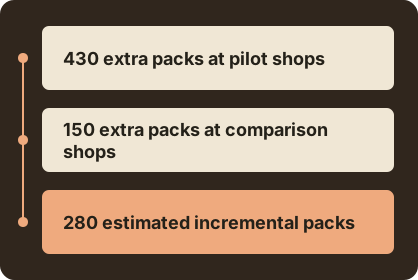
Build the counterfactual
Subtract the comparison increase of 150 packs from the booth-store increase of 430. The estimated effect is 280 packs. An alternative adjustment applies the comparison growth rate of 15% to the booth stores’ 1,050-pack baseline. That yields 272.5 incremental packs and ₹29,975 of contribution. Both approaches put the full campaign below its ₹36,000 cost. Neither adjustment removes bias if the shops would have followed different trends without booths.
Compare the three choices
Repeat at the existing fee and the estimated loss is ₹5,200. The observed lift supports a maximum flat fee of ₹30,800 before any return hurdle. Commuter shops account for 190 incremental packs and ₹20,900 of modeled contribution. If six booths cost ₹18,000, that implies ₹2,900 of headroom. The residential cluster contributes only ₹9,900 against an equivalent ₹18,000 fee. These subgroup estimates are exploratory and may reflect the original store-selection process.
Recommend a limited renewal
Reserve six commuter locations only if the fee is below ₹20,900 and a test is feasible. Pair eligible shops on sales, trend and availability, then randomize within pairs and audit stockouts. At an ₹18,000 fee the pilot needs at least 164 incremental packs. Use this as the commercial hurdle and report the uncertainty alongside the result. Do not count assumed repeat purchases until a later follow-up provides evidence.